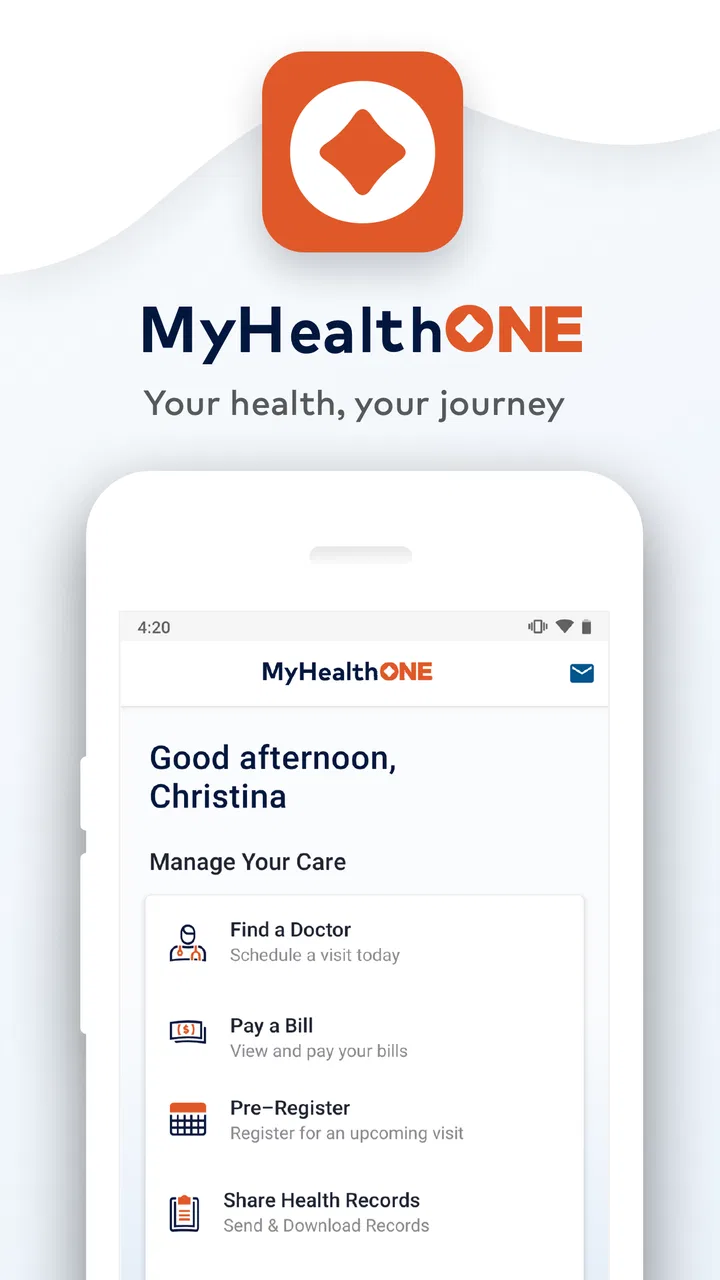
MyHealthONE
- 4.0
- Rating
- 500.00K
- Installs
- Free
- Price

 Analysis by App-foxy
When a health task begins with a practical problem rather than a medical question, MyHealthONE is designed to be the place I would check first. It is a free medical app from HCA Healthcare Inc, built around the idea of keeping patient information and care-related tasks together instead of scattering them across paper notes, phone calls, and separate hospital contacts. I found its value strongest when I treated it as a personal health-portal companion, not as a diagnostic tool.
The difference matters. This is not an app I would open to decide whether a symptom is serious, replace a clinician, or manage an emergency. I would use it when I need to stay organized around care connected with the HCA Healthcare network: preparing for an appointment, checking available health information, or keeping track of what needs attention next. That focused role makes it easier to understand, but it also means the app is most useful to people whose care is connected to the service behind it.
Following a patient task from the first question to the next step
I start this section with the practical question behind a patient task: what am I trying to find out, and what would count as a useful next step? That framing helps me use the portal deliberately rather than browse sensitive information without a purpose. From there, I look at how the workflow changes once I move from finding context to deciding whether I can act on it myself or need to contact the care team.
You May Also Like

 Blood Strike: 2.5 Anniversary
Blood Strike’s Loadouts Turn Every Drop Into a Tactical Gamble
A close look at Blood Strike’s custom loadouts: how fast access to signature weapons reshapes its battle royale rhythm, rewards preparation, and narrows the gap between fights.

 Pandora - Music & Podcasts
Pandora’s Music Is Easy to Start, but Harder to Recover
Pandora’s strength is its low-effort path from a seed to a station. Its weak spot is how much confidence it asks you to place in connection, setup, and quiet recovery.

 8 Ball Pool
 Is Built on Rivalries, Rematches, and Routine
A close look at the rivalries, rematches, shared routines, and unanswered safety questions that turn a quick pool match into a persistent mobile community.

 Samsung Music
’s Quiet Strength Is Playing What You Already Own
Its reach comes less from spectacle than from dependable access to a personal library. That simplicity is both the app’s strongest retention engine and its ceiling.

 AccuWeather: Weather Radar
AccuWeather Review: A Quick, Clear Forecast for Everyday Decisions
For everyday plans, the best forecast is the one you can understand quickly. AccuWeather makes rain timing, radar, and local conditions easy to act on, with a few trade-offs.

 Hill Climb Racing
Why Hill Climb Racing Still Turns Crashes Into One More Run
A tiny car, a bumpy hill and one more upgrade: Hill Climb Racing keeps resurfacing because its simple chaos makes every near-miss feel personal.
More From Our News Desk



Starting with the situation that brought me to the app
A realistic example is a routine appointment that has been scheduled but still leaves several loose ends. I may want to review the details, check whether information from a previous visit is available, or make sure I have a clearer picture of what happens next. Instead of searching through messages and calling a general number immediately, I would open MyHealthONE and begin by looking for the relevant patient-portal information.
That starting point is more useful than the short label “Patient Health Portal” might suggest. A portal is valuable because it gives context to an individual care journey. The app is not simply a collection of medical articles; it is intended to connect the patient with information associated with their healthcare experience. In my view, that makes it more practical for ongoing care than a general wellness app that offers advice but knows nothing about a particular appointment or provider relationship.
I would also begin with a realistic expectation: the app can help me access and organize information, but it cannot guarantee that every part of a care process will happen inside the screen. Healthcare still involves reception desks, nurses, physicians, laboratories, billing departments, and sometimes outside providers. MyHealthONE can reduce some of the gaps between those steps, but it does not remove the need for human handoffs.
Moving through the portal instead of guessing
My first useful habit would be to look for the item connected to my immediate need rather than browsing every area at once. If I am preparing for a visit, I would focus on appointment-related information and any patient details that could affect the conversation. If I am checking after a visit, I would look for newly available information before contacting the facility again. This simple order keeps the app from becoming another place where I collect information without acting on it.
One non-obvious advantage of this workflow is that it can improve the quality of a phone call. Before calling a hospital or clinic, I can check what is already visible in the portal and write down the exact gap: an unclear instruction, a missing update, or a question about the next step. That is much better than making a vague call and repeating information that is already available. The app becomes a preparation tool, not merely a viewing screen.
I would keep a short personal note outside the app with questions for the appointment, especially if the issue is complicated or involves several medications. A patient portal can help me retrieve information, but it is not a substitute for my own preparation. The strongest workflow combines the app’s records and updates with a concise list of what I need a healthcare professional to explain.
Understanding the handoffs between patient and provider
The most important part of a medical portal is often not the screen itself but the handoff it supports. I enter or review information, the healthcare organization processes it, and a clinician or staff member may respond through the care process. Each transition can introduce delay or confusion. MyHealthONE is helpful when it gives me a clearer place to begin and a more definite sense of what information belongs to my care.
For example, if I have recently interacted with an HCA Healthcare facility, I would use the portal to review what is connected to that encounter before assuming that a separate call is necessary. If the information answers my question, I save time. If it does not, I can approach staff with a more precise request. That is a meaningful improvement over relying on memory, especially after a stressful appointment when instructions can be easy to forget.
There is also a family-care angle. When helping someone else organize healthcare, the main challenge is often not understanding medical language but keeping track of which facility handled which part of the process. A central portal may make that organization easier, although I would still be careful about whose account I am using and whether I am authorized to view another person’s information. Health information deserves the same caution I would apply to banking or identity documents.
Another practical insight is to treat portal updates as part of a sequence rather than as a complete conversation. If I see new information, I would read it alongside the instructions I received in person. If the two appear inconsistent, I would contact the facility rather than choosing whichever version seems more convenient. The app can surface information, but a clinician or authorized staff member is the right person to resolve a medical contradiction.
What the experience is like in everyday use
MyHealthONE makes the most sense for someone who wants a single patient-facing route into care connected with HCA Healthcare. The app is free, has an Everyone content rating, and has reached over 500 thousand installs. Those details suggest that it is intended for ordinary patients and families rather than a narrow professional audience. I would recommend it to a person who is comfortable using a phone for practical administration and wants to reduce dependence on paper records.
The app’s current version is 1.9.4, and it has an average rating of 4.2 from around 7.7 thousand ratings, with roughly 1 thousand written reviews. I read that overall reception as encouraging but not as proof that every patient will have a smooth experience. Medical portals depend on account matching, facility participation, current records, and timely updates. A positive rating can reflect a good experience for one patient while another still encounters a frustrating handoff.
In daily life, the strongest use case is the “small but important” task: checking something before leaving home, confirming what I already know, or gathering context before asking a staff member for help. I would not expect it to replace every administrative channel. Instead, I would use it as the first layer of organization, then move to a call or in-person conversation when the matter needs clarification or action from the care team.
Where the workflow can break
The first possible break is access. A patient portal is only useful when I can successfully reach the right account and see the relevant information. If the account setup, identity matching, or sign-in process becomes confusing, the app can feel like an extra barrier rather than a shortcut. I would avoid repeatedly guessing credentials or creating duplicate accounts. A careful recovery or support route is safer, particularly when the information involved is sensitive.
The second break is timing. A patient may assume that an item will appear immediately after an appointment or that a message will receive a rapid response. That assumption can create unnecessary anxiety. I would use the app to check for updates, but I would not treat the absence of an update as evidence that something is wrong. For urgent concerns, I would use the appropriate clinical or emergency channel rather than waiting for a portal notification.
The third break is interpretation. Medical information can be accurate and still be difficult to understand without context. A result, instruction, or clinical term may require explanation from a professional. MyHealthONE is not the right tool for self-diagnosis, and I would be cautious about making treatment decisions based only on what I can read in the portal. Its best role is to help me ask better questions and remember what has been documented.
The fourth break involves care outside the connected network. If I see a specialist, pharmacy, laboratory, or hospital that does not share the same portal relationship, I may still need another app, a paper document, or a direct call. This is where a general health-record organizer might be more convenient for someone whose care is spread across many unrelated providers. MyHealthONE is more compelling when the center of my care is within the HCA Healthcare environment.
How it compares with the usual alternatives
Compared with calling a facility for every question, the app offers a more private and less disruptive first step. I can review what is already available before taking time from a receptionist or nurse. That does not make phone support unnecessary, but it can reserve calls for issues that genuinely need a person. For routine organization, I prefer that balance.
Compared with paper folders, a portal is easier to check when I am away from home and less likely to leave one important document buried under another. Paper still has a place, particularly for instructions I need immediately or information from providers outside the network. I would not discard useful documents simply because I installed the app.
Compared with broad health and fitness apps, MyHealthONE has a narrower but more relevant purpose. A wellness app may be better for exercise habits, nutrition tracking, or general education. MyHealthONE is better suited to the administrative and informational side of being a patient. Choosing between them is not really a matter of which is universally better; they solve different problems.
Compared with a general record-keeping app, its advantage is the connection to a specific healthcare organization. Its trade-off is that this connection can be less useful when my providers are spread across unrelated systems. I would choose MyHealthONE when my immediate need is care linked to HCA Healthcare Inc, and I would add another method for keeping a broader personal overview if my medical life extends beyond that network.
Small habits that make the app more useful
I would open the app before an appointment, not only after one. Reviewing the information already available helps me spot questions while there is still time to ask them. I would also check it after the visit, when instructions are fresh, and compare what I see with the notes I made in the room. This two-stage habit turns the portal into part of the appointment workflow rather than a passive archive.
I would avoid using screenshots as my only record of important health information. A screenshot can be useful for quick reference, but it may lack surrounding context and can remain on a phone longer than intended. For sensitive details, I would use the portal itself when possible and keep my device protected. This is a practical privacy habit, especially if other people occasionally use the same phone.
For a family member, I would prepare the exact facility name, approximate visit context, and the question that needs answering before opening the app or contacting support. That preparation can make a handoff much faster. It also reduces the chance of mixing up two appointments or asking one department to solve a problem that belongs to another.
Finally, I would distinguish between “information I can review” and “action that requires confirmation.” Seeing an instruction is not the same as knowing how it applies to my situation. I would use the app to gather the first part and a qualified healthcare professional for the second. That distinction is the most important safety-minded habit I took from using a patient portal.
Who should use it, and who may prefer something else
I think MyHealthONE is a good fit for patients who receive care through HCA Healthcare facilities and want a more organized way to follow their patient information. It is also useful for people who dislike making routine calls, tend to misplace paperwork, or want to prepare more effectively for conversations with clinicians. Since it is free and rated for Everyone, the barrier to trying it is relatively low for ordinary patients.
I would be less enthusiastic about it as a primary solution for someone whose care is mostly outside the HCA Healthcare network, someone seeking symptom analysis, or someone who expects a portal to coordinate every provider automatically. A different health-record tool may be better for a highly fragmented care history, while direct clinical contact is better for urgent or confusing medical concerns.
My final impression is that the app succeeds when I use it for what it is: a patient-facing bridge between my own organization and the healthcare system. It can make the path from “I need to check something” to “I know what to ask next” more manageable. The experience still depends on accurate account access, timely information, and human follow-up, so I would not mistake convenience for complete coordination.
Still, I would recommend MyHealthONE to a friend whose care is connected with HCA Healthcare Inc. The strongest result is not that it eliminates every phone call or replaces a medical professional. It gives me a clearer starting point, helps me prepare for handoffs, and makes routine patient administration feel less scattered. For that specific job, it is a sensible free medical app rather than a generic health utility.
FAQs for MyHealthONE
01What is MyHealthONE and how does it enhance my healthcare experience?
MyHealthONE is a comprehensive healthcare management app designed to streamline your medical journey. It provides easy access to your medical records, appointments, and billing information. By centralizing this data, it enhances your healthcare experience, making it more efficient and organized, allowing you to focus on your well-being without the hassle of paperwork.
02How secure is my personal information on MyHealthONE?
Security is a top priority for MyHealthONE. The app uses advanced encryption protocols to safeguard your personal and medical data. Additionally, it complies with HIPAA regulations to ensure that your information is protected and confidential, giving you peace of mind when managing your healthcare needs.
03Can I schedule and manage appointments through MyHealthONE?
Yes, MyHealthONE allows you to conveniently schedule, reschedule, and cancel appointments with your healthcare providers. You can also set reminders and receive notifications, ensuring you never miss an appointment. This feature helps streamline your healthcare management and saves you time and effort.
04Is MyHealthONE compatible with all healthcare providers?
MyHealthONE is compatible with a wide range of healthcare providers within its network. However, it's essential to check if your specific provider supports the app. You can usually find this information on the provider's website or by contacting their customer service for confirmation.
05Are there any costs associated with using MyHealthONE?
MyHealthONE is free to download and use for basic features such as viewing medical records and managing appointments. However, some advanced features or services may require a subscription or additional fees. It's advisable to review the app's pricing details within the app store or on the official website for comprehensive information.
Pros
- User-friendly interface for easy navigation.
- Secure access to personal health records.
- Appointment scheduling with reminders.
- Integration with wearable health devices.
- 24/7 access to medical support resources.
Cons
- Limited availability in certain regions.
- Occasional sync issues with devices.
- Some features require in-app purchases.
- Interface may be overwhelming for new users.
- Notifications can be excessively frequent.

MyHealthONE
Gallery